Monday, September 28, 2009

The Other White Meat


Here's a fossil of Archaeotherium, a large piglike animal that hunted small animals and also ate plants and carrion when it could find any. Some of these piggies grew as tall as 5 feet at the shoulder.

Archaeotherium's fossil is on display at the Badlands Visitor Center, along with a model of what scientists believe it looked like.

We wouldn't want to find one of these rooting around our campsite—not with those chompers—but it is time for lunch, and bacon sandwiches (of prehistoric, bacon-like sandwiches) sound a lot better than the usual peanut butter and jelly.

Here, piggy piggy...


Mako Sica

Is not the sky a father and the earth a mother, and are not all living things with feet or wings or roots their children?
—Nicholas Black Elk, Lakota spiritual leader, 1932


The Lakota called this place mako sica. French trappers knew it as les mauvaises terres รก traverser. Both have the same meaning: Bad Lands.

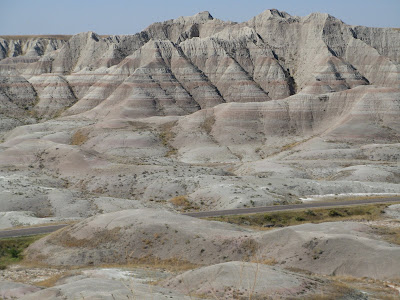
We arrive at dusk, as has become our routine to enter the national parks, and we find a tragically beautiful place. It's eerie and ethereal, mystical and haunted by the sound of wind rustling the grasses and insects buzzing across desolate plains. We enter the park Sept. 16 with the sun setting beyond the colorful, banded wall, glowing in soft purple and orange hues. As the moon rises we drive the Badlands Loop and listen to American Indian songs while an owl glides over the prairie and a massive buck stands near the road. We see their earthly form but prefer to think of them as ancient spirits assuming animal shapes.

After setting up camp, we take Ophie to the amphitheater for the ranger's nightly program. Tonight's toipc: Prairie, which once sprawled across one-third of North America. Only 2 percent remains.

Badlands contains mixed-grass prairie, tall-grass species including big bluestem and prairie cordgrass, and short-grasses such as blue grama and buffalo grass. Today, prairie dogs, muledeer, pronghorn, bison, coyotes, big-horn sheep and black-footed ferrets live and thrive in the park. We watch and listen to the ranger's presentation and appreciate the still, subtle beauty of the grassland, and gaze up at the stars covering the dark, moonless sky.


In the morning, we wake to the Western Meadow Lark's melodic birdsong. It's hot—88 degrees in this land of extremes—and our plans for an intense morning hike quickly fade. Instead, we take a fossil walk and see bygone creatures from millions of years ago like the Leptomeryx, a small, deer-like animal, sheep-like Oreodonts, ancient pigs called Archaeotherium, Mesohippus, a three-toed ancestor of modern horses, and Subhyracodon, a small, plant-eating rhinoceros.

Next stop: Big Foot Pass.

This is the place where Chief Big Foot led about 350 men, women and children down the Badlands Wall on Dec. 24, 1890. Five days later, nearly 200 of them were massacred at Wounded Knee, just to the south. It's an emotional place—much more so, I'm sure, for Lakota descendants.

Next time, we'll visit the Stronghold Table (we're driving the North Unit; it's in the South Unit, through rutted tracks and closed gates) and stand in the place where the Lakota men danced the Ghost Dance for the last time before Wounded Knee. We leave Badlands less than 24 hours after our arrival. But the pictures in our minds of Lakota families pushed across this hard, desolate landscape in the dead of winter—when we don't even want to leave the comfort of the air-conditioned truck to hike a few miles through the canyons—driven to their death haunts us still.

—Jessica


Deadwood


Deadwood, South Dakota: Final resting place of Wild Bill Hickok and Calamity Jane, and current nesting place of casinos and kitschy, Old West storefronts and bars.

We stop by Mt. Moriah Cemetery to see Wild Bill and Calamity Jane's gravesites.

Hickok was shot in the back of the head and killed Aug. 2, 1876, while playing poker at Saloon No. 10, and a Dead Man's Hand, black aces and eights, sits beneath his headstone.

Martha Jane Burke, aka Calamity Jane, rests alongside Wild Bill. During her 53 years, she worked on a bull train, performed in a Wild West show and worked as a prostitute. She didn't have much luck at the latter, probably because of her appearance. Most historians agree her claim to be Wild Bill's sweetheart was strictly a figment of her imagination. Regardless, her dying wish—to be buried next to the famed lawman—was granted, cementing her place in local lore and alongside her imagined lover.

In addition to its two most famous spirits, Mt. Moriah is also the final resting place of many colorful characters, like Preacher Smith, a Methodist minister and medical doctor who was well loved by the community and murdered enroute to church, and Dora Dufran, a big-hearted madam with brothels in Lead, Rapid City, Deadwood and Belle Fourche. Children's graves (many died from smallpox) are also found throughout the cemetery, along with a Civil War veterans section.

After nearly getting duped into buying a beer at the so-called Saloon No. 10, we stumble upon Wild Bill Bar, and notice its sign that reads, "Historic Site, Saloon No. 10, where Wild Bill was shot, Aug. 2, 1876. The original bar burned down and was then rebuilt and renamed in honor of its most well-known murder victim.

We toast Wild Bill with a Black and Tan, check out the poker room display with mannequins reenacting Hickok's final hand, eat a burger, and drive like hell through the Black Hills and into Badlands.

The Wild West inspires potential Halloween costumes: Wild Pat Hickok and Calamity Jess.

Four Faces of Freedom

Upon recommendation of several park rangers at Wind Cave, we decide to wait until evening to head up to Mount Rushmore to see the lighting ceremony, the monument's main attraction that inspired a 2,500-seat amphitheater that fills up almost every night between Memorial and Labor days.

We arrive about an hour before dusk not really expecting much other than presidents’ faces in stone and perhaps a trail below them. What we find is much, much more. The monument is beautifully laid out; the entrance has the feeling of a Roman architecture with four flights of stairs leading into huge stone columns that reveal the first glimpse of the Rushmore faces. Upon entering the main grounds there’s a long walkway with every state’s flag and huge stone pillars leading up to the amphitheater site. With the usual gift shop, eatery, and a very well put together museum/visitor center we’re both impressed with Mount Rushmore.


The night is pleasant and warm, so we decide to grab some waffle cones with huge scoops of ice cream mounded on top. Jessica gets strawberry cheesecake and I get my favorite mint chocolate chip. The prices are surprisingly reasonable and we head down and get a seat, front and center. Studying the faces they almost seem fake in their perfection, a true testament to the sculptor Gutzon Borglum. It was his idea and vision to sculpt Washington, Jefferson, Lincoln and Roosevelt upon these rocks instead of what was originally supposed to be heroes of the west like Lewis and Clark, Wild Bill or Red Cloud.

As the ceremony approaches we’re joined by a little old lady wearing a stars-and-stripes sweater and sporting a proud grin on her face as she sees the 1,000 plus people roll in. We start chatting and she tells us she’s part of the Mount Rushmore Foundation, which plays and important roll in the upkeep of the park (lawmakers wrote a section in the legislation guaranteeing no fee to enter the park). But thanks to a clever loophole, there's now a $10 fee for parking. Our new friend is full of other pieces of information and historical facts, and we both find her knowledgeable and charming. One interesting story she tells us is that this summer, three Greenpeace activists snuck up to the top and hung a huge banner over the faces with a message for President Obama, "America Honors Leaders not politicians, stop global warming."

Darkness is now upon us. A ranger comes out and plays presidential triva games with the crowd until everyone is finally settled. Every answer is one of the presidents on Rushmore, and within every set of four questions, each of the four presidents gets a nod. This is only the start of what feels like a junior high history lecture. The following video that provides the highlights of each president’s life proves to be very laughable and elementary but nonetheless does show that each man had a great impact on the America in which we live and certainly enjoy. Finally at the end, the spotlights shines and the faces are revealed against the dark starry sky, a beautiful sight that is only dimmed by the urging of the rangers to join along with the recording and sing America the Beautiful.

Upon returning to our Wind Cave campsite, we light a fire and pull out our amateur astronomy book and do some constellation identifying. The sky has so many stars that it almost makes it harder to find things. But we have fun anyway and now feel confident that if we were lost in the woods we could find our way out.

—Patrick

Friday, September 25, 2009

Alvin's Place


Wind Cave National Park is located about a half-hour south of Mount Rushmore in the Black Hills of South Dakota. We initially didn't know much about it or even have it on our radar of things to do, but our national parks book convinces us that it's probably worth checking out. We decide to make it our destination after leaving Devils Tower. We make our usual late-night entrance after an all-day-and-night drive, and pull in around 11:30pm. Between some detours that weren't planned—or fun—that we won't mention at this point, the road being different than we expected, and the fear that a deer is going to jump out in front of us at any moment (seriously an issue around these parts!) we drive like grandma on Sunday and finally arrive.

The campground is more like a big picnic park area with bermuda style grasses and huge prairie lands. After getting camp set up and cracking a Rolling Rock (Jessica's cheap beer choice, not so good without lime-aid) we realize that we're standing underneath the most spectacular sky either one of us have ever seen! Life is once again good, and our trip—and 12-hour driving day—have meaning.

Wind Cave is surprisingly the seventh-oldest national park and fifth-longest cave system in the world at the moment. Cave exploration is an ongoing craft, and experts know that there must be more than the 135 miles that are documented. An expo at the 1893 World's Fair in Chicago sparked enough awe and interest that the government commissioned a survey crew to see it first-hand and report back with their data. They unanimously agreed that it was worthy and joined: Yellowstone (first national park); Sequoia (second); Yosemite (third); Kings Canyon (fourth); Mount Rainier (sixth); and Crater Lake (seventh). With the addition of Wind Cave, what was considered worthy of protection changed.

The history of Wind Cave starts with the Native Americans in the area who revered it as sacred and never tried to explore it. The first westerners credited with its discovery were two brothers who had chased a wounded deer down a ravine and stubbled upon the entrance hole. But the main credit for it becoming a protected park goes to a young boy not yet 18 years old.

Alvin McDonald moved to the Black Hills in 1890 when his father was commissioned to run the South Dakota Mining Co. claim in the area. Gold had been discovered and prospectors were flooding in by the hundreds to find their fortune. Alvin being a young boy was less interested in prospecting and more interested in exploring. One day he happened upon the entrance to Wind Cave. What we haven't told you is that the entrance (photo, below) to the cave is only 14 inches across, from the photo and in person we're more that amazed that anyone could have or would have wanted to crawl into this crack in the ground. For the next three years, Alvin spent every waking moment in the cave and chronicled it in a journal that is displayed on the park's website. It was he and his father who took the exibit to the Worlds Fair in Chicago, started the initially tourism in the cave, and provided the first maps of the caves to the government surveyors. Here's an entry from his journal:

Friday Jan 23rd, 1891
We got up late this morning and I started into the cave at 9:15 A.M. with W Stirling of Hay Springs Neb and Frank Stirling of Sault Ste Marie, Mich. as follows. We started for Mound Builder's Rest and got there at 1:00 P.M. After looking around a while we struck a passage leading to the left and went through a narrow passage for 700 feet before finding anything of interest. We then found a flat room with four passages leading from it. We finally chose the passage that lead south and then East. After following this passage for about a quarter of a mile through open rooms we found a place where there had been a heavy fall some ancient period because the rocks are all stuck together with sediment of some kind. I found a geode with white crystals in it at the bottom of the pile. After running out our string we returned to the flat room with the four passages leading from it. I and Walter left Frank with the string so we couldn't get lost and explored the other passages. I found nothing in the west passage and he found nothing in the East passage. Then we both went the N.E. passage and found a room of beautiful crystallized box, lattice and bracket work together with some fine geodes. After backing up in good shape we started for the entrance and arrived at 6:30 P.M. after 9 hr 15 minute trip. Were plenty tired when we got out and.....supper ..... folks went to bed and left me at 9:00 P.M. and I think I will get to bed at 10:00 P.M. Have given up the idea of finding the end of Wind Cave. Good night, Cora.

Understanding that cave exploration in theses days was made possible with candles and a simple ball of string makes Alvin's accomplishments pretty amazing. At one point on the tour our guide tells us a story from Alvin where his string broke and he ran out of candles before he could find the exit. After 60 hours in the dark Alvin found his way out. Pretty amazing. Then the guide turns off the light and we discover what complete darkness is and that it was very amazing someone didn't find his bones years later!

Another great story from our guide, who himself is an avid Wind Cave explorer, came just weeks before we arrived. He and a few other park employees were mapping a new section of the cave when they came upon a room with several passages leading out. His passageway opened up and as he tells it, his excitement grew as he realized there was a large room at the end. In the caving world when you discover a new room you get to name it. He said there was a special feeling being the first person in this room until his head lamp spotted something on the wall that read Alvin McDonald July 4, 1893, with a smile he knew he was in Alvin's Place.

—Patrick Hardcastle

A Pleasant Detour


The benefit of studying the atlas several times in the morning before leaving is that you'll find hidden gems that detour off of the planned route and in many cases get a "I didn't even realize we were that close," comment. While headed for the Black Hills, I notice Devils Tower National Monument is just a short loop north before we hit South Dakota and our turn south. The famed rock of so many sci-fi geeks and UFO searchers is a place that I've always longed to see (hopefully that gives you a little insight in who I am.) On the drive in I almost clean out a suicidal turkey, which may have been good for our food budget and Ophie's birding instincts, but bad because we don't have a lot of extra room for a 40-pound bird.


The Kiowa, the local native american tribe, have a legend that goes something like this: "Eight children were there at play, seven sisters and their brother. Suddenly the boy was struck dumb; he trembled and began to run upon his hands and feet. His fingers became claws, and his body was covered with fur. Directly there was a bear where the boy had been. The sisters were terrified; they ran, and the bear after them. They came to the stump of a great tree and the tree spoke to them. It bade them to climb upon it, and as they did so it began to rise into the air. The bear came to kill them, but they were just beyond its reach. It reared against the tree and scored the bark all around with its claws. The seven sisters were borne into the sky, and they became the the stars of the Big Dipper."
Native American legends are better than strict science and modern religions!!!


On the way out we see a little spot called Devils Tower View. It's a bbq/gift shop/taxidermy spot and in most normal cases we wouldn't stop but they have Buffalo Burgers posted on the sign outside and we've been talking about trying one for the last several hundred miles. The shop is run by a very friendly older couple who's hospitality and food is matched only by the views of Devils Tower behind the shop. We're surprised to find out that they have wireless internet and it's a good chance to catch up on a few things before hitting national park land that has NO internet connections anywhere! We each grab a burger and a Devils Tower lager, grab a sticker and some huckleberry honey, say our farewells, snap a quick photo and we're off!

A Pleasant Detour.

Extra-Super 8


Super 8 in Powell, Wyoming. A shower and a bed never felt so good. It's got everything we need: Wi-Fi, a TV, a hot tub, laundry and Pizza Hut next door. We overindulge in all of the above. When we leave Super 8, heading to South Dakota, all three of us smell fresh, like lavender and vanilla. After two nights sleeping in a motel room we are ready to sleep outdoors and hear nature's noises instead of indoor air conditioning.

When we finally arrive in Wind Cave after a 12-hour drive from Powell, a wildlife symphony of elk, owls, coyotes and crickets welcomes us back to their world.